
How to work from home with no childcare and actually stay sane
How to work from home with no childcare and actually stay sane

Your toddler wants a snack at 9:03am, right after you've opened your laptop.
Your eight-year-old's "pupil-free day" landed on the exact day you had three deadlines.
The baby napped for forty minutes instead of two hours, and now your whole afternoon is rearranged. Again.
If you're nodding along, here's the first thing I want you to hear.
You don't lack discipline. You don't need more willpower. You're not bad at this.
You're trying to run a 9-to-5 system in a house that has never worked that way. The problem isn’t you, it’s the system.
Perfect balance is a lie
The reality is that the kind of balance where work and kids each get their fair, tidy share of the day isn't coming. Not this month, not when they start school, not ever, really.
But that’s okay, because what you actually need isn't balance, it's a way of working that matches the task to your actual state, not the hour on the clock.
Some hours you're sharp, while some you're functional but a bit foggy around the edges, and others you're running on fumes and any task that needs real thought is off the table. It’s not a lack of discipline; it's just where you're at, and the work should bend to meet you there instead of the other way round.
Why the 9-to-5 system was never going to work for you
Corporate scheduling assumes a few things: a quiet room, a closed door, someone else handling the kids, eight uninterrupted hours in a row…
You might have a toddler underfoot all day, or a baby who feeds every two hours. You might have school-age kids whose "reliable" school day gets cancelled by sick days, or a random Wednesday off that you swear nobody warned you about.
None of that is a scheduling problem that you can fix by just trying harder. It's a mismatch between the tool and the job, because a time-blocked calendar built for someone with a locked door was never going to survive contact with the WFH mum reality.
So, we build something else.
The three zones: Sharp, Steady, Low
Instead of asking what time it is, ask what energy zone you're in. That one shift can significantly change how the day feels.
Sharp. Clear-headed and focused. You can hold a complex thought without it sliding away. This is where deep work, strategy, creating, and real decisions belong. Don’t waste this window on admin, emails, scrolling, etc. Protect it with one focus task and close off interruptions where you can.
Steady. Functional. You can work through a list of tasks, but you’re not about to break new ground. This is where emails, admin, scheduling, and light edits belong. But the big decisions and creative work don't. You can batch similar tasks together here rather than jumping between types to help minimise context switching.
Low. Foggy and perhaps a bit short-fused. This is where tasks like templates, scheduled posts, passive research, and invoicing belong, but anything needing your full attention doesn't. The goal here isn't to push through; it's to accept the energy zone and pick tasks that don't ask more of you than you've got.
None of these zones are ‘bad’. Low-zone hours still get real things done; they just need the right task assigned to them. The exhaustion most of us feel isn't from having low-energy hours; it's from trying to do Sharp-zone work during a Low-zone hour and wondering why it's taking three times as long and feeling twice as hard.
What this looks like on three different kinds of days
A day with a newborn. Your windows are short and unpredictable, maybe twenty minutes between feeds if you're lucky, and you genuinely don't know which zone you'll land in until you're in it. Keep one Low-zone task ready to go at all times. If you get a rare Sharp window, brilliant, and if you don't, the day still moves forward.
A day with a toddler underfoot. You get real windows, nap time or an hour they're occupied, but you don't always know when they'll start or how long they'll last. Have one task ready for each zone so whichever one shows up, you've got something that fits it, instead of staring at a to-do list that assumes you're sharp when you're not.
A day with a school-age kid home sick. You thought you had six hours. You have maybe ninety unpredictable minutes, spread across a day of temperature checks and boredom-busting, and you'll likely be running Steady at best. Protect your one non-negotiable task, whatever zone it needs, and let everything else drop to Low-zone or tomorrow.
These are all different days with the same three zones. That's the point.
The load nobody sees isn't just the tasks
Here's the part most productivity advice misses entirely. It's not just that your day is unpredictable, it's that you're the one holding the entire mental map of the household while it happens.
Knowing when the next appointment's due, noticing a child's feeling off before they say a word, holding the logistics in your head before they’re written down, remembering what's running low in the cupboard, the bathroom cabinet, the first aid kit. None of that shows up on a to-do list, but all of it is work, and most of it is invisible to everyone else in the house.
This is worth naming out loud, even if it’s just to yourself, because you can't hand off a load nobody can see. Once it's written down, three things become possible that weren't before: you can see how much you're actually carrying, you can decide what genuinely has to stay with you, and you can hand the rest to someone else with a specific, nameable task instead of a vague plea for "more help."
Try this today, in under five minutes
Before your next work window starts, whenever that is, do this:
Name your energy zone right now. Are you feeling Sharp, Steady, or Low? Be honest, not aspirational
Pick one task that actually fits that zone from your to-do list
Do that task, and only that one, before you let anything else pull at you
Write down one thing currently living in your head that isn't actually yours to carry alone
And now the whole shift is in motion.
Start here, for free
I built the WFH Mum Daily Planner because I needed something that actually worked with my day, not assuming eight quiet hours and a closed door. One top goal instead of ten. A place to brain-dump whatever's cluttering your head before you even start. A running list for the 10-minute windows and the tasks you can do with a kid on your lap. A Carry Forward section for the things that don't happen today, because something always doesn't, and that's not a failure, it's just Tuesday.
It's free, and it's the easiest place to start putting any of this into practice today.
If you want the zones built in
Everything in this post (the energy zones, the mental load list, the partner briefing) lives in the full Energy-Based WFH Mama Planner. A five-minute Zone Audit in week one maps out when your windows actually tend to land, so the whole system works around your real life instead of guessing. Daily and weekly pages sort your tasks by zone, and the Mental Load List and Partner Briefing turn everything you're carrying into something you can actually see and share.
It's the paid, full version of what you've just read. Worth a look once the free planner's earned its place in your day.
You're not failing at a system that was built for you; you're actually succeeding at surviving one that never was. Let's fix that.
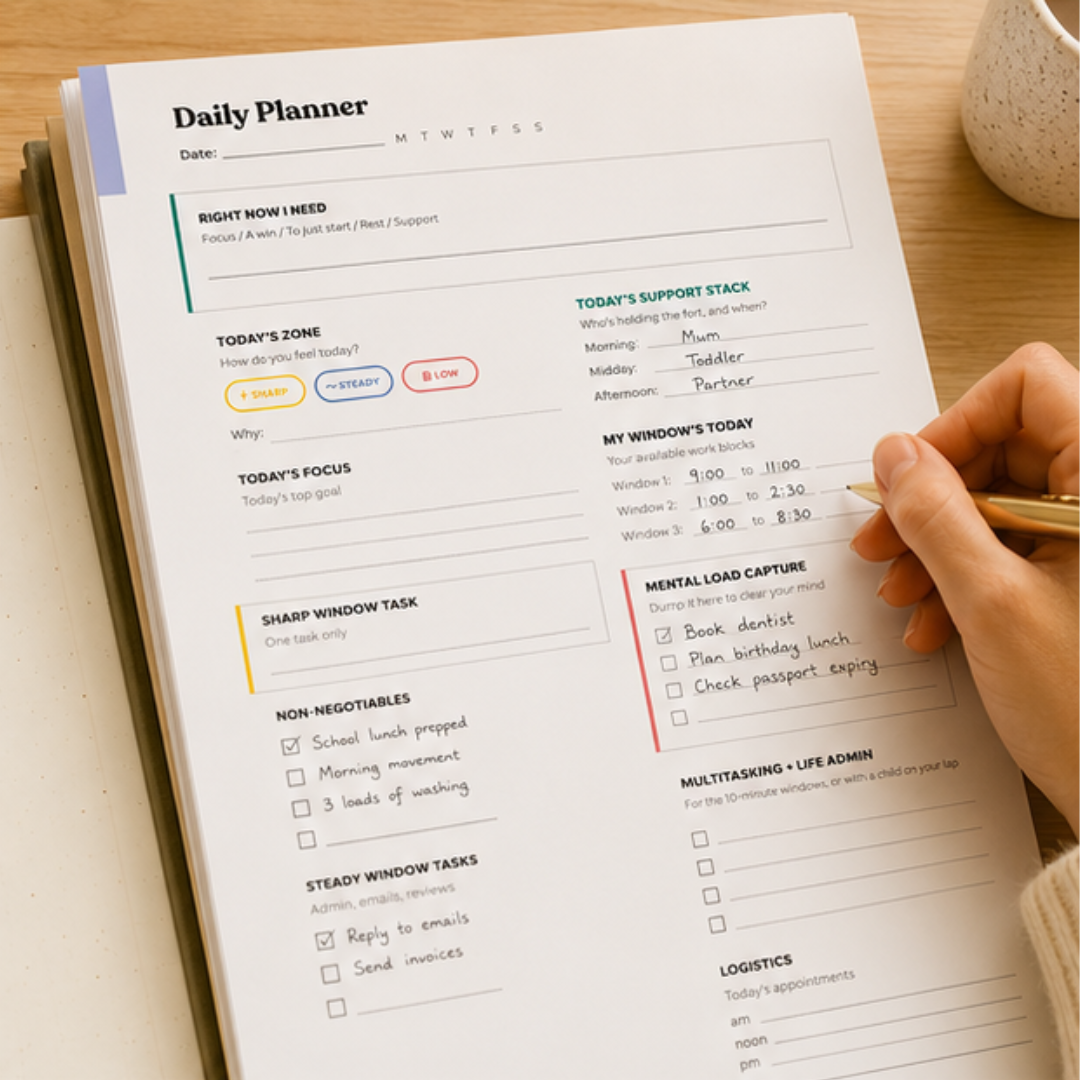
A daily planner built around the time you actually have.
Not the uninterrupted hours you wish you had. Print it, use it, and stop keeping it all in your head.
Get the Free Planner