
My brain runs from 6 am. Here's how I keep it from running away, as a WFH mum.
My brain runs from 6 am. Here's how I keep it from running away, as a WFH mum.

From the moment I am up, my brain is already running.
Work tasks, toddler activities, that appointment I keep forgetting to reschedule, and the perpetual mystery of what is actually in the fridge for dinner. All of it. Simultaneously. It runs in both directions… work surfaces during playgroup, while family logistics creep into my early morning meetings. There’s no clean handover between roles because, for most WFH mothers, there rarely is one.
For a long time, I assumed this was just the tax you pay for flexibility. But while it never seemed like something I could really ‘fix’, eventually I started working out how to support it instead.
The advice that misses the point
There is a version of this conversation (probably somewhere online already) that ends with a suggestion for a morning routine or a new meditation app. Admirable intentions, certainly. But they don't solve the problem.
As a WFH mum, ‘relaxing more’ won’t take away the mental load. When you are carrying this much information (client deadlines, kids’ appointments, everyone else's schedules), your brain holds on tight. Of course it does. It is a completely rational response to a heavy cognitive load.
The moment I understood that, I stopped trying to "relax" my way out of it and started building the scaffolding to hold it for me.
The system: simple, and deliberately so
This didn’t happen overnight. There was no dramatic epiphany. It just gradually became the way I operate, because it works for me.
My calendar is the backbone. Everything with a time attached goes in. Work calls, yes, but also playgroups, social catch-ups, and the reformer sessions I would otherwise sacrifice first. If it isn't on the calendar, it doesn't exist.
The calendar handles the "when." Everything else (the tasks, the to-dos, the small loops that rattle around in my mind) goes into task management. I use a digital tool for planning all my tasks and to-dos, as specifically as possible (write it down now and set it to remind me when it actually needs to be done), and a physical daily planner for actually thinking through the day ahead. Two tools, two distinct jobs.
Simple beats perfect. Always. A system you will actually maintain on a Tuesday afternoon when the toddler is screaming is worth ten beautifully designed ones you abandon by Wednesday.
I don’t have a rigid shutdown time or routine
I don’t have a fixed end to my working day. And that isn’t a gap in my system; it’s a feature.
I manage my work around a family-first life, which means flexibility is a two-way street. Some days I finish early, and we walk to the park. Some days, I pick things back up once the house is quiet and the kids are asleep, or I’m working on something urgent up until dinner time. A rigid shutdown routine would work against my life, not with it.
What I have instead is a system robust enough that I am not carrying open loops in my head, regardless of when I stop. Everything is already captured somewhere reliable.
The mental load doesn’t disappear. But it becomes manageable once you stop trying to hold it all yourself.
The shift
When things do slip (and they do, because life is messy), I notice it, I sort it, and I move on. The guilt doesn’t linger the way it used to because I trust the process. Not because it’s perfect, but because it’s consistent.
That’s the shift. It isn't a move from chaos to total calm. It is about moving from fighting the chaos to having something solid underneath it.
You don’t need an elaborate setup. You need one that is simple enough to use when you’re stretched thin, reliable enough to trust, and honest enough to actually fit your life, not someone else’s version of it.
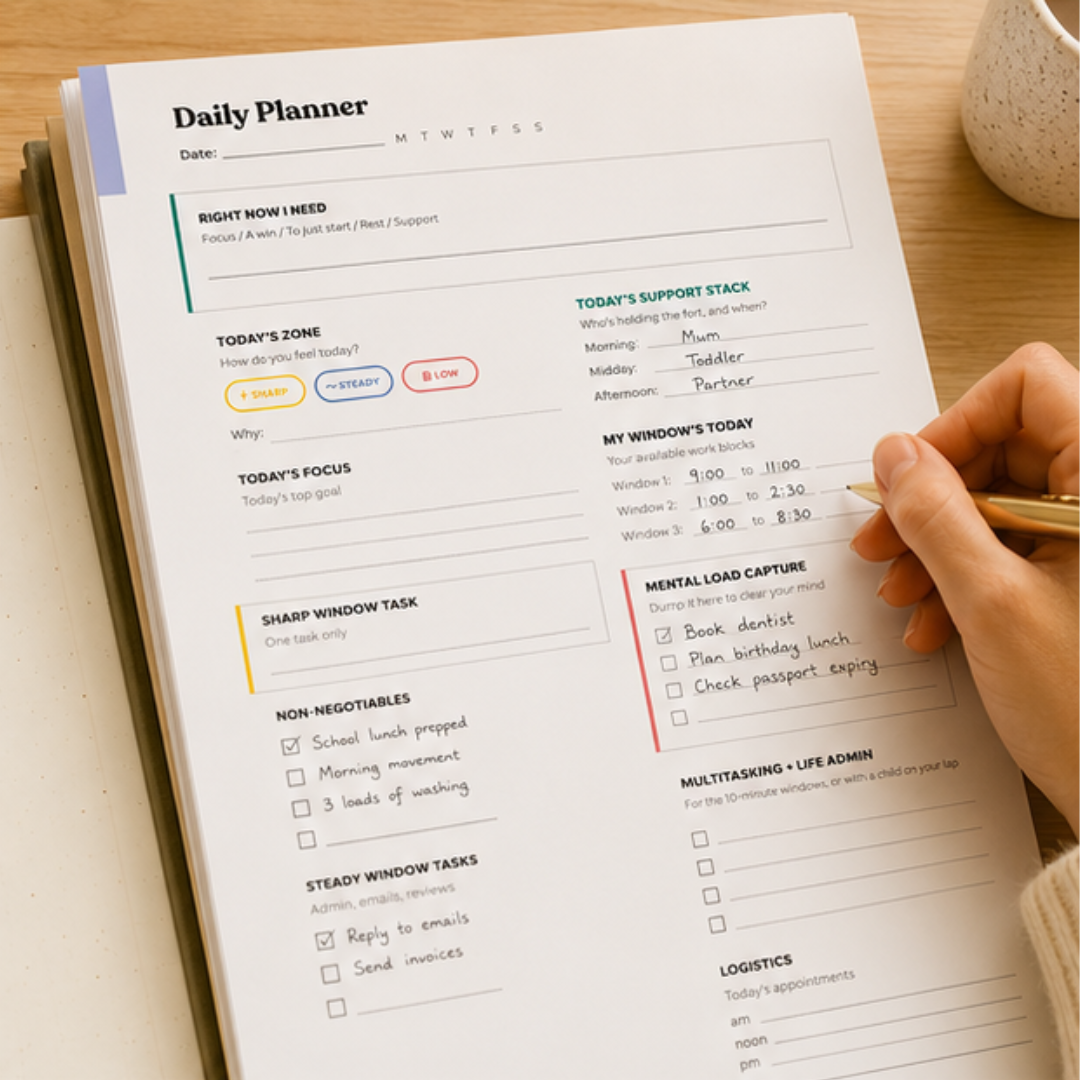
A daily planner built around the time you actually have.
Not the uninterrupted hours you wish you had. Print it, use it, and stop keeping it all in your head.
Get the Free Planner