
The Mental Load of Working From Home: What It Is (and How to Actually Share It)
The Mental Load of Working From Home: What It Is (and How to Actually Share It)
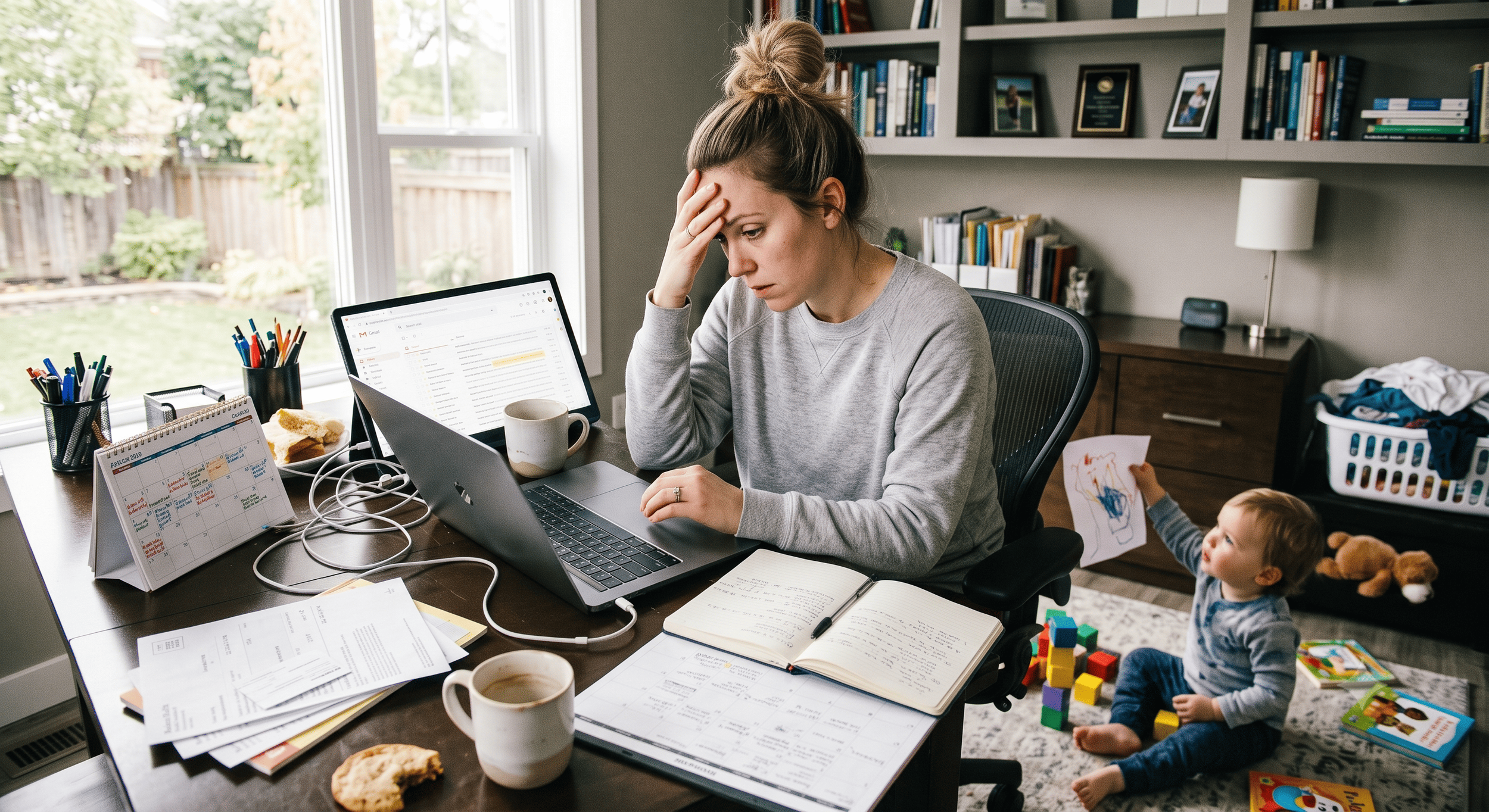
I finished up a meeting last week, and as soon as it ended, my brain switched straight to whether I had remembered to pull something out of the freezer for dinner, whether I’d booked the kids in for their gymnastics classes. Whether I'd actually sent that email I was working on that morning. Things that I'd been carrying the whole time, sitting there waiting for the second there was a gap, because my brain never truly rests.
The mental load is the invisible thinking, tracking and planning that keeps a household running. And the reality is that working from home often makes it worse, because there's no commute, no office, and no physical line between "work mode" and "home mode" to give your brain a break from either one.
If you're a mum working from home, whether in a paid job or your own business, you already know this deep down, even if you've never had the words for it. Let's get into what it actually is, why WFH makes it heavier rather than lighter, and what actually helps.
What the mental load actually is
The mental load is the ongoing, mostly invisible work of noticing, remembering, planning and anticipating everything a household and a family need. It's different from doing the dishes or packing a lunchbox. It's knowing the lunchbox needs packing, knowing what's actually in the fridge to put in it, remembering your youngest won't eat crusts this week, and holding all of that in your head before you've touched a single piece of bread.
It's not really about the tasks themselves, but about being the one who keeps track of them. You can hand someone a task. It's much harder to hand someone the remembering.
A normal Tuesday in a WFH mum's head might include some combination of:
What will be for dinner that night and whether any ingredients are needed or the meat has been pulled out of the freezer.
Whether the children’s activities have been booked in.
Which things in the home are running low and need to be ordered/restocked.
What the toddler has eaten, and will eat, and whether they are getting a balanced diet.
When the next pay is coming in and which bills need to be paid now, and which wait until after.
A client deadline, an invoice, or a deliverable that's due today.
Who’s birthday party is this weekend and what to get them as a present.
What time the baby last had a feed or a nap and when the next one is due.
That email from last week that never got a reply, that needs to be followed up.
None of that is dramatic on its own, but stacked together and running on a loop, it's exhausting in a way that's hard to explain to someone who isn't carrying it.
Why working from home makes the mental load heavier, not lighter
This is the part that doesn't get talked about enough, and it's the reason this article exists.
People assume working from home should make the mental load easier to manage. You're right there. You can throw the washing on between meetings. You can sign the form without leaving your desk. In theory, more flexibility should mean less pressure.
In practice, it often means the opposite, for a few specific reasons.
There's no commute to switch you off. A mum who works from an office gets a drive or a train ride that draws a line between "work brain" and "home brain". When you work from home, that line doesn't exist. Work thoughts and home thoughts run in the same room, at the same desk, often in the same minute.
Being home gets read as being available. If you're physically in the house, it's easy for everyone, including you, to assume you're the default option for anything that comes up. The school calls about a sick kid. The plumber needs someone to let them in. The parcel needs signing for. It doesn't matter that you're mid-deadline. You're there, so it's yours.
Nobody sees the juggle, so nobody accounts for it. In an office, colleagues see you stressed, see you duck out for a call, see the visible cost of a hard day. At home, the juggling happens silently behind a laptop screen. Your partner comes home to a tidy-ish house and a kid who's been fed, and has no real sense of what it took to get there while you were also meant to be working.
Work and home never fully clock off. An office job has a start and an end. WFH mum life often means checking Slack after bedtime because that's when the house finally went quiet, then being back on nappy duty or school-run logistics before 7 am. The mental load doesn't get a shift change. It just keeps running.
This is the piece missing from most articles on this topic. The mental load isn't just a parenting issue or a relationship issue for WFH mums. It's what happens when the mental load of running a household and the mental load of running a job or business share the exact same hours, the exact same house, and the exact same brain.
Why "just ask me" doesn't actually fix it
If you've raised this with a partner, you've probably heard some version of "just ask me, I'll help." It's usually said with good intentions, but it's also not really the fix that it sounds like.
When you have to ask, you're still the one who noticed the task existed, worked out what it involves, and decided when it needed doing. Asking someone to help is still you managing and them executing. You've outsourced one step and kept the other four.
This is where the idea of domain ownership comes in, and it's worth being specific about what it actually means, because "share more" is too vague to act on.
Helping looks like: "Can you grab nappies on your way home?" Owning looks like: nappies are your partner's thing. They notice the stock is low. They buy them. They know which size your baby has just grown into, without being told.
Helping looks like: "Can you sign the excursion form?" Owning looks like: school forms and payments are your partner's domain. They check the app. They know the excursion is coming up before you mention it.
The shift from helping to owning is the difference between someone doing a task and someone actually carrying it. It's the only version of "sharing the load" that gives your brain any real space back.
What actually helps
None of this fixes itself with one conversation, and it's not about scoring points. But there are a few things that genuinely shift the weight over time.
Write it all down. Not a curated version that seems reasonable, but the full list, from baby wake windows to your teenager's part-time job roster, to the invoice you keep meaning to chase. You can't share something the other person can't see, and most partners genuinely don't know the volume until it's in front of them.
Have the conversation outside the moment of frustration. Nothing productive comes from raising this at 9 pm after a form gets missed. A calm, separate conversation, framed as "I need this to be shared differently" rather than "you're failing me," tends to be received more positively.
Assign domains, not tasks. Pick full areas, not individual jobs. One person owns school and childcare admin, the other owns meals and groceries. The domain owner does the noticing as well as the doing.
Put a weekly check-in on the calendar. Ten minutes at the same time each week, where you both look at what's coming up. This is what makes shared ownership actually work day-to-day, rather than being a nice idea that ultimately reverts back to you after a few days.
Let it be done differently. If you take a domain back because it wasn't done your way, you've just proven that owning it was never really available to your partner. If the washing gets folded differently, that’s okay.
Build in a hard stop for work. Since WFH removes the natural line between work and home, you may need to create one on purpose. A set finish time when you close the laptop and stop working, a specific chair you only work from. It sounds small, but it's one of the only things that actually protects your brain from running both loads at once.
If you're doing this without a partner to split it with
Some of you are carrying this entirely solo, whether that's by circumstance or by choice, and there's no system in this article that redistributes a load that only has one person to carry it. What tends to help here isn't a perfect system. It's a genuine village: other WFH parents to share school pickups with, a group chat where admin gets shared instead of duplicated four separate times, and being upfront with people about your actual capacity instead of silently absorbing more than you can hold.
If the load is affecting more than your to-do list, if it's sitting in your sleep, your patience, your sense of self, that's worth being honest about with someone you trust, or a GP.
Frequently Asked Questions
What is the mental load in simple terms?
The mental load is the invisible thinking, planning and remembering behind running a household, separate from actually doing the physical tasks.
Why is the mental load worse for mums who work from home?
There's no commute or physical separation between work and home, so the mental load of your job and the mental load of your household run at the same time, in the same space, without a natural break.
What's the difference between helping and owning a task?
Helping means someone completes a task when asked. Owning means someone notices it needs doing, plans it and completes it without being managed or reminded.
How do I bring this up with my partner without starting a fight?
Raise it outside a stressful moment, be specific rather than general, and frame it as wanting a shared system rather than pointing out what's being done wrong.
Can the mental load be shared if I work from home and my partner works from an office?
Yes, though it usually takes a deliberate system rather than a natural default, since being physically home tends to make you the default option unless domains are clearly assigned.
If you're in the thick of this right now, you're not doing it wrong. The systems most of us were handed were never built for a mum running a household and a job out of the same four walls. That's exactly why I built the free WFH Mum Daily Planner, designed for the version of your day that actually exists, unpredictable windows and all.
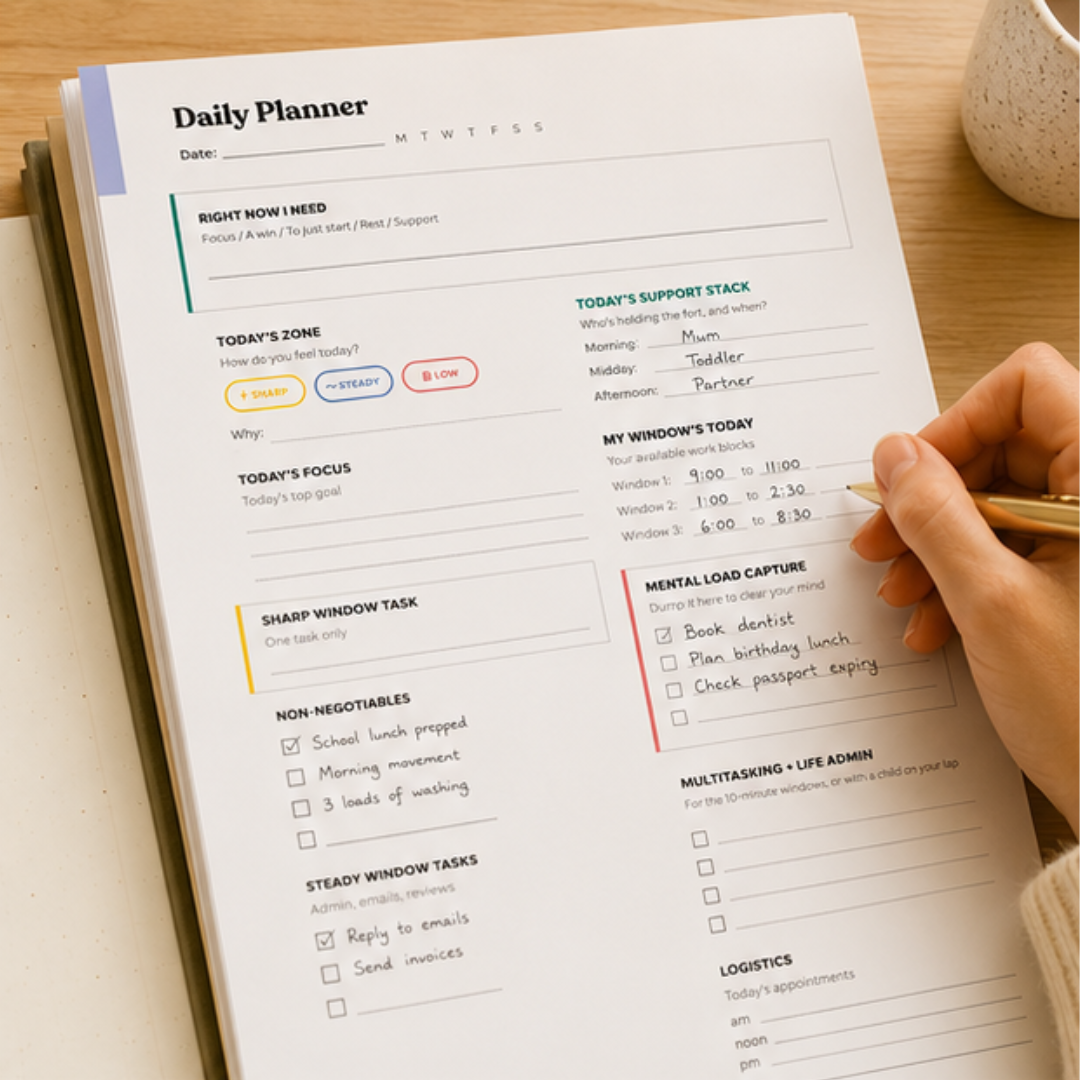
Get the mental load out of your head. And off your shoulders.
The Energy-Based WFH Planner includes the exact tools you need—from the Mental Load Tracker to the Partner Briefing—to actually build a shared system.
Get the Full System